
The term “technological innovation” encompasses any new application of technical knowledge that modifies an existing use or creates a new one. In 2024 and 2025, three axes structure the concrete changes in everyday digital tools: the European regulation on artificial intelligence, the deployment of autonomous software agents in cloud services, and the evolution of interfaces between the physical and digital worlds.
European AI Act: what the regulation changes for everyday tools
The European AI regulation (AI Act) was adopted by the European Parliament on March 13, 2024, and then validated by the EU Council on May 21, 2024. This text is not limited to a theoretical framework: it imposes specific obligations on digital services that most users employ every day.
The first visible consequence: online platforms will have to implement clear labeling of AI-generated content. Any image, text, or video produced by an artificial intelligence system must be marked as “synthetic content” or by an equivalent mention. Search engines, social networks, and video conferencing tools are directly concerned.
The regulation also prohibits certain uses in public spaces, particularly real-time facial recognition for law enforcement purposes, except for very tightly regulated exceptions. For systems classified as “high risk” (health, credit, employment), enhanced requirements for training data management and risk analysis apply.
Following technological innovations on I Announce allows for an overview of how these obligations are reflected in common digital products.
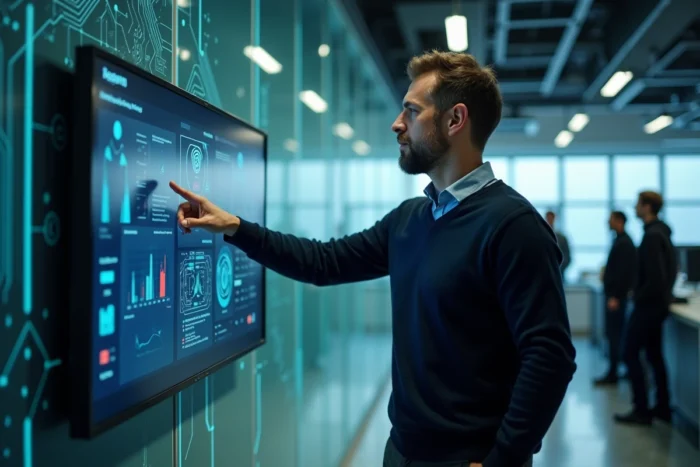
Autonomous AI agents: from concept to deployment in the cloud
The notion of AI agent refers to a software system capable of executing a sequence of tasks without human intervention at each step. Unlike a traditional chatbot that responds to a single request, an agent plans, decides, and acts over several successive steps.
Major cloud service providers have begun integrating these agents into their offerings for businesses. The goal: to automate complete business processes, such as order processing, support ticket management, or generating an analysis report from raw data.
What distinguishes an agent from a conversational assistant
- An assistant answers a specific question, while an agent chains multiple actions to achieve a predefined goal
- An agent can query databases, trigger actions in third-party applications, and adjust its strategy based on intermediate results
- Human supervision remains necessary to validate final results, but manual intervention between each step disappears
This industrial deployment raises questions about data governance. When an agent accesses sensitive information to make automated decisions, the traceability of its reasoning becomes a technical requirement, not just a regulatory one.
Physical and digital interfaces: sensors, glasses, and robots
CES 2025 highlighted several categories of products that illustrate how the boundary between the physical environment and digital technologies is shrinking. Three families of products deserve particular technical attention.
Connected mirrors and home health sensors
Devices like the Omnia mirror analyze health parameters (heart rate, skin condition) directly from the bathroom. These tools rely on optical sensors coupled with real-time analysis algorithms. Health data is processed locally, which limits risks associated with transfer to remote servers.
Integrated display glasses for professional use
Two approaches coexist. Consumer glasses, like those from Halliday, project a screen into the user’s field of vision to check notifications or navigate. Professional models, like the VisionX, target industrial operations: guided maintenance, quality control assisted by augmented reality.
The technical difference lies in the available field of vision and the robustness of the hardware. Workshop use requires resistance to shocks and dust that consumer models do not guarantee.
Robotics and learning in simulated environments
The Nvidia Cosmos platform illustrates a fundamental trend: training robots in virtual environments before their physical deployment. The robot learns to manipulate objects, move, and react to obstacles in a simulation, then transfers these skills to the real world.
This method significantly reduces development time and costs associated with physical prototypes. It applies to both logistics and automated commercial photography, as demonstrated by the GENCY PB photography robot presented at CES.

Data governance and digital management in companies
The accumulation of these technologies (generative AI, autonomous agents, IoT sensors) produces a volume of data that companies must structure. Data management becomes a direct operational issue, not just a topic reserved for IT teams.
- The obligations of the AI Act require documentation of the datasets used to train high-risk AI models
- Autonomous agents require actionable activity logs to trace each automated decision
- Health sensors or home IoT devices generate personal data subject to GDPR, which implies explicit consent and an effective right of access
For companies deploying these tools, the question is no longer whether they need to organize their data governance, but how quickly they can do so before regulatory obligations fully apply.
The AI Act provides for a gradual implementation over several years. The prohibitions on the riskiest uses apply first, followed by obligations for transparency and labeling. Each wave of implementation will concretely modify the interfaces of the digital tools used daily, from the search engine to the health app.